From Messy Email Threads to Structured Reports
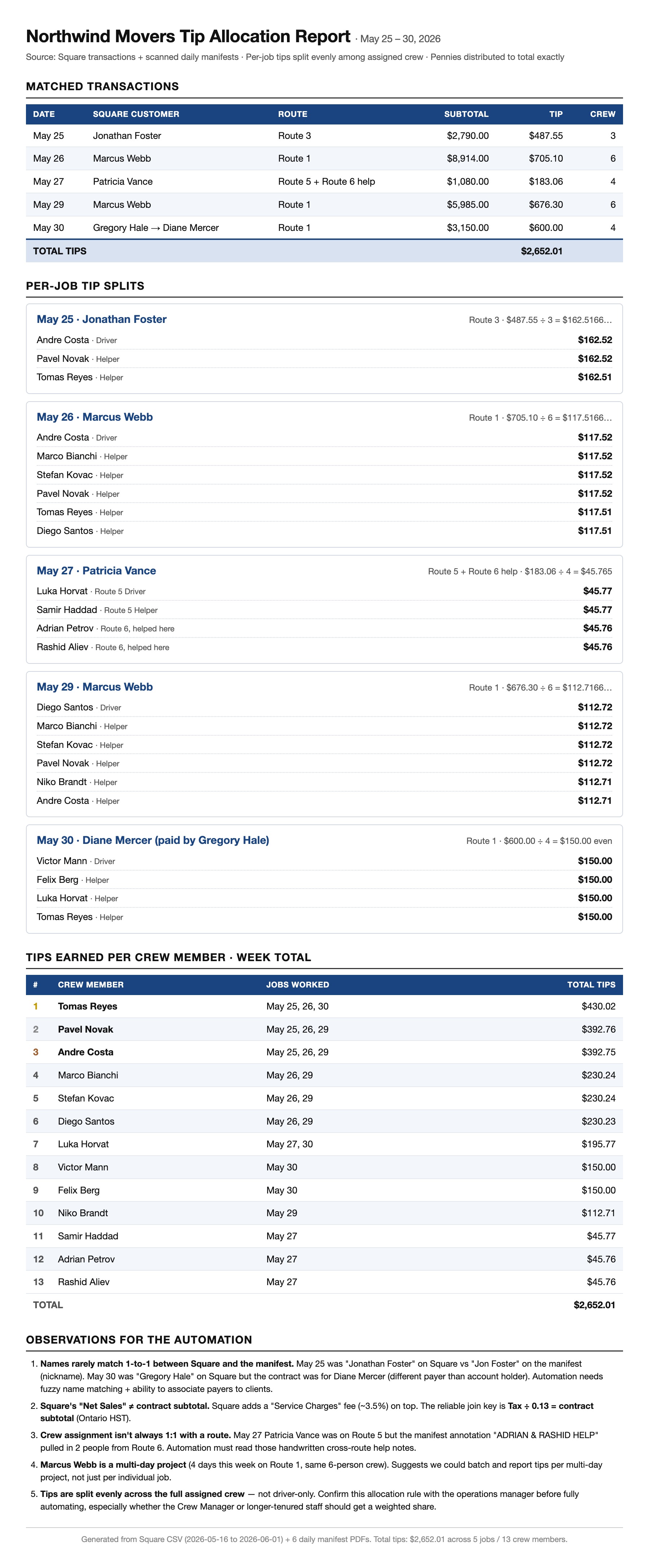
A real report the system generates automatically — names and company anonymized.
The Problem
A moving company ran its weekly operations across half a dozen disconnected places: payment records in Square, crew assignments in handwritten and scanned daily manifests, and a constant stream of email and chat conversations confirming who paid, who worked, and which jobs got combined.
Every week, a manager had to manually cross-reference all of it — matching payments to jobs, working out which crew worked which route, and splitting tips fairly down to the penny. It took hours, the numbers had to be exact, and a single mismatched name or missed "helped on another route" note could throw the whole calculation off.
The Solution
We built a tool that ingests the raw, unstructured inputs — the Square transaction export, the scanned PDF manifests, and the surrounding email conversations — and turns them into one clean, structured report. The AI does the reading and reconciling that a person used to do by hand:
- Reads the messy inputs. It parses scanned manifests and free-text email threads, pulling out jobs, routes, crew lists, and the handwritten "X & Y helped here" annotations.
- Matches across systems. It uses fuzzy name matching to reconcile nicknames and different payers (e.g. "Jonathan" vs "Jon", or a spouse paying for a contract booked under another name) between Square and the manifests.
- Runs the calculations. It splits each job's tips evenly across the assigned crew, distributes leftover pennies so the totals reconcile exactly, and builds a per-person weekly leaderboard.
- Generates the report. It outputs a clean, shareable PDF — plus a list of edge cases it flagged for a human to confirm.
The Result
What used to be a multi-hour manual reconciliation became a report generated on demand in seconds. The output is consistent, the math reconciles to the cent, and the manager's job shifts from doing the calculations to simply reviewing a handful of flagged edge cases.
More importantly, it proved a repeatable pattern: most businesses are sitting on valuable information trapped inside unstructured emails, PDFs, and exports. With the right AI pipeline, that scattered, manual analysis can be turned into structured, reliable reporting — freeing people from repetitive number-crunching to focus on the work that actually matters.