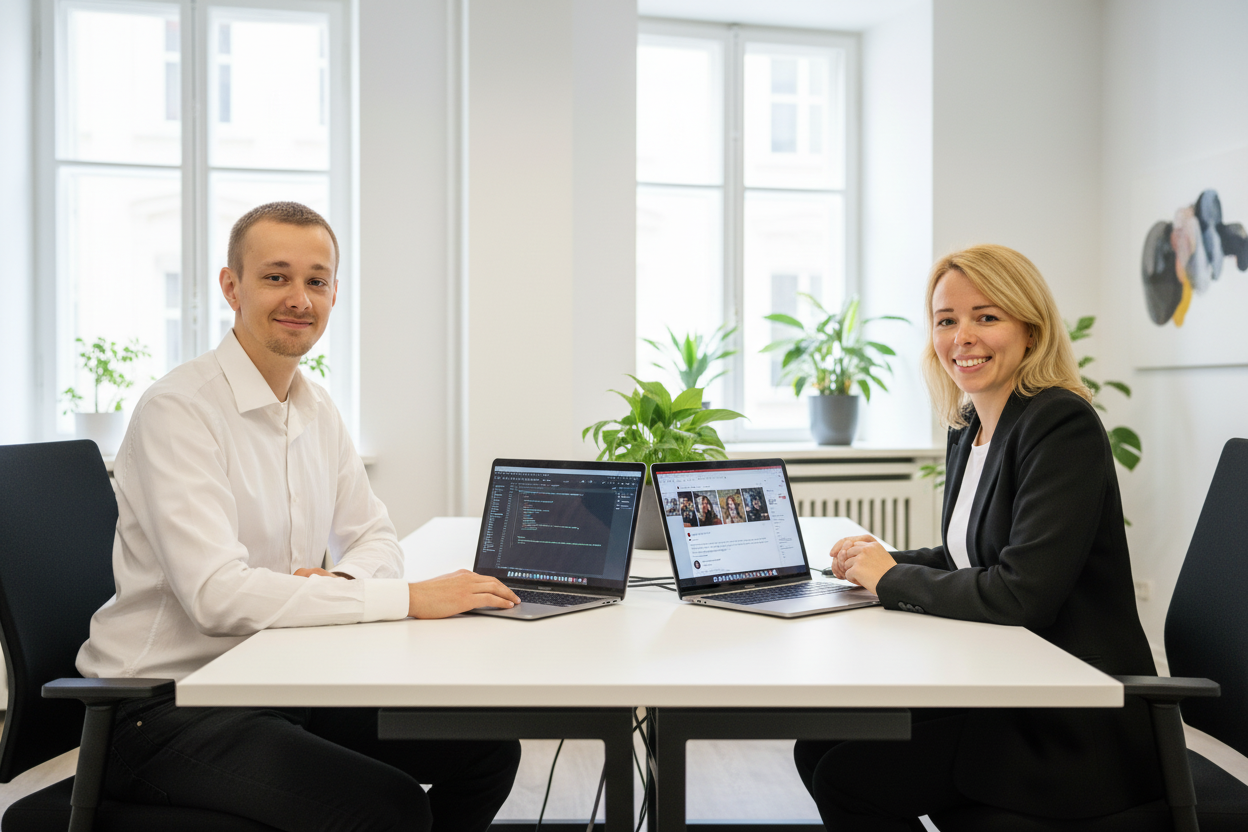
I'm Cyril Kats — an independent developer focused on applied AI. I help businesses safely explore whether modern AI can solve specific operational problems through small, low-risk experiments.
We are a family-run business led by me, Cyril, and my lifelong partner, Kateryna.
Before working independently on applied AI, we spent over 16 years co-building and operating PropertySpaces, a real estate photography business based in Toronto. Since 2008, we grew it from a one-person operation into a team managing more than 1,500 appointments a year with seven photographers.
Running a busy service business meant dealing with real operational issues every day — scheduling, coordination, invoicing, follow-ups, and constant trade-offs between efficiency and reliability. When existing tools didn't fit our needs, we adapted our workflows and put supporting systems in place to keep operations reliable and manageable.
That experience still guides how we work today. We focus on understanding real processes and constraints first, then carefully exploring whether modern AI can practically reduce friction through small, low-risk experiments — with an emphasis on clarity about what works, what doesn't, and why.
Kateryna is a founding partner in all of our ventures and plays a key role behind the scenes, overseeing administrative operations and ensuring consistency, follow-through, and clear communication. Her attention to detail and commitment to quality have been essential to how our businesses operate.
Today, through {CK} Web Solutions, we work independently and deliberately — combining long-term operational experience with applied AI experimentation to help organizations explore new possibilities without unnecessary risk.
Choosing the Right AI Model
We test AI models on real-world tasks to reveal strengths, limits, and the best fit for your use case.
Vision & Image Analysis
Models capable of interpreting images, identifying objects, and extracting visual meaning.
Scikit-learn — Random Forest (lightweight patterns)
Reasoning & Validation
Models used to verify, filter, and sanity-check outputs from other systems.
Models we work with:
OpenAI — o1 (complex multi-step reasoning)
OpenAI — o3-mini (fast logical validation)
Anthropic — Claude 3.5 Sonnet (fact-checking & analysis)
Google — Gemini 2.0 Flash Thinking (chain-of-thought)
DeepSeek — R1 (open-source reasoning)
Many real-world problems require combining several of these capabilities into a single workflow. We help you choose the right models for each step — balancing accuracy, speed, and cost — and test whether the approach holds up before it’s ever deployed.
Selected Case Studies
Here are just some of the case studies we conducted to confirm or rule out AI feasibility for real-world business problems.
Indoor Navigation Using AI + 3D Mapping SUCCESS
We combined Matterport 3D scans with OCR to create an indoor navigation system for grocery stores. The AI reads product names directly from shelf images, maps each item to exact 3D coordinates, and provides turn-by-turn directions — like Google Maps, but inside the store. Customers find any product in seconds instead of wandering aisles.
AI Book Recommendations from Live Inventory SUCCESS
We built a chatbot for bookstores that understands natural language queries like "something like Harry Potter but for adults" and recommends only books currently in stock. The system combines ISBN-based inventory data, Google Books metadata, semantic search, and LLM validation in a multi-stage pipeline that delivers genuinely intelligent suggestions — not just keyword matches.
We built a video analytics pipeline that counts store visitors and identifies demographics — gender, age, and children — from entrance camera footage. Traditional face-based detection failed at distance, so we used OpenCLIP to classify from body appearance instead. The system achieved 90% accuracy, giving the client proof-of-concept data for upper management.
Local Speech-to-Text for Faster AI Prompts SUCCESS
We built a Chrome browser plugin that uses OpenAI Whisper running entirely on your computer — no cloud, no subscription, no per-minute fees. Dictate detailed prompts in seconds instead of typing them. One of the simplest and most effective AI tools we've created, proving that sometimes the best solution is a small tool that removes everyday friction.
AI-Powered Real Estate Photo Enhancement PARTIAL SUCCESS
We tested whether generative AI models could automate professional real estate photo retouching — window pulls, sky replacement, and object removal. The retouching quality was impressive, but models still introduce subtle "hallucinations" that alter reality. For MLS listings requiring pixel-perfect accuracy, this technology isn't ready yet — but progress suggests it will be soon.
We evaluate and prototype the most suitable AI models for a specific problem — from documents and images to audio and text — using real data to determine feasibility, accuracy, and limitations early on.
Multi-Step AI Systems
"Imagine an AI solution where each task is handled by the model best suited for it — not one model trying to do everything."
We design multi-step AI workflows that combine different models into a single system, allowing complex tasks to be broken down, validated, and handled more reliably than with a single approach.
AI Connected to Your Data
"Imagine customers asking intelligent questions about your inventory or operations — without exposing your real-time data publicly."
We connect AI models directly to your existing databases and internal data sources, so answers are grounded in your information, not generic knowledge — while keeping control over what is visible and what stays internal.
Working at the AI Frontier — Beyond Generic Models
"Imagine a problem that was difficult or impossible to solve a few months ago suddenly becoming straightforward."
AI tools and models evolve constantly. We keep track of new capabilities as they emerge, researching and testing what's newly possible — including tools you may not even know exist — so opportunities aren't missed simply because the landscape moved too fast.
AI Performance & Cost Optimization
"Imagine getting accurate answers fast — without paying for more intelligence than the task actually needs."
Different AI models vary widely in speed, cost, and capability. We test and select models that are appropriate for each task — avoiding underpowered models that fail and overpowered ones that are unnecessarily slow or expensive — to keep systems efficient, responsive, and cost-effective.
Transparent AI Cost Tracking
"Imagine knowing exactly what an AI system will cost — before it's ever used at scale."
We track and measure model usage during experiments so costs are clear and predictable. That means understanding what pricing units actually represent, how much a specific task consumes, and what scaling would cost in practice — long before any real-world deployment is considered.
OUR PROCESS
Step 1
Problem Discussion
We start with a short conversation to understand the problem, constraints, and why existing approaches may not be working.
Step 2
Focused AI Experiment
We design and run a small, contained experiment using real data to test feasibility, accuracy, cost, and limitations.
Step 3
Clear Outcome
You receive a clear assessment of what works, what doesn't, and whether the idea is worth pursuing further.